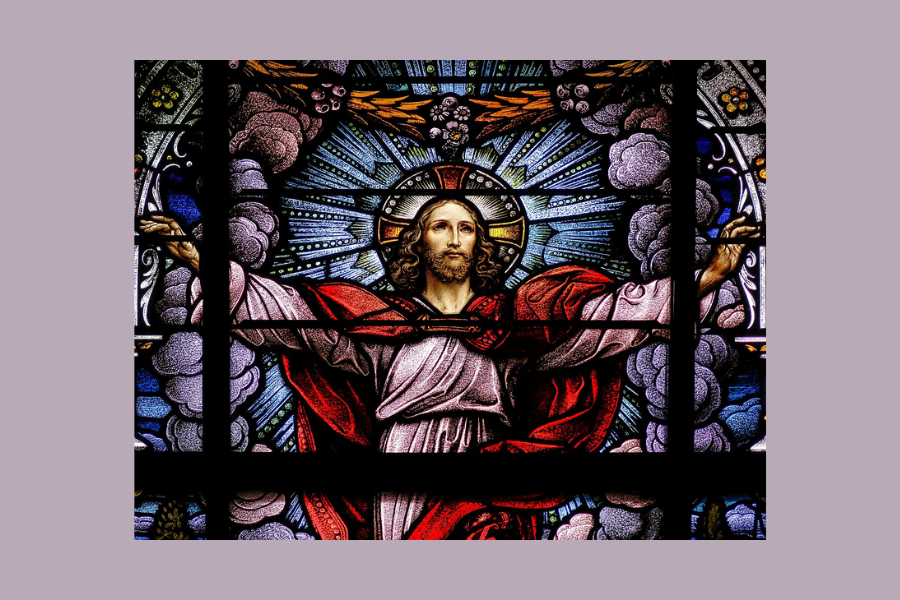
Today is Ascension Thursday. While almost all dioceses in the United States have transferred the solemnity to the seventh Sunday of Easter, Msgr. Peter, Jenn, and I all live where it remains on the 40th day after Easter (with Easter counted as the first day), in one of the ecclesiastical provinces of Boston, Hartford, New York, Omaha, and Philadelphia, as well as the Personal Ordinariate of the Chair of Saint Peter. For us, today is a Holy Day of Obligation with all the necessary additional Masses to provide the Faithful with extended opportunities to worship.[1]
Christ’s ascension culminates the four stunning acts of immense love Jesus endured to save our debased human nature. Of these four, the Ascension seems to get the least attention; rather the only attention it gets is in relation to Pentecost. In the days before, we hear much about how Christ must ascend in order to send the Holy Spirit, then in the days after, we pray that the Holy Spirit comes, as Jesus instructed the disciples to do for nine days with Mary in the upper room – the Church’s first and only official novena.
The odyssey of Jesus began when the Father sent the Son to form the most intimate bond possible – the hypostatic union – with a human soul and its flesh in the person of Jesus. One person, two distinct and complete natures so intermingled that they cannot be separated, yet they remain unchanged and without confusion. This He did for our salvation. As incarnate, He taught us morality through his bodily words and actions. He suffered with us who have doomed ourselves to lives inseparable from suffering and fated to endure the final common suffering of all – death. This, too, Christ endured, so we may witness the brutal nature of our sins and the abyss of love He has for us in what He suffered. The Father sent Him on this mission, and Christ willingly came to suffer, because suffering is the perfect means by which we are to be saved. Now our suffering is no longer useless but meritorious, continuing His work of salvation when united to the infinite merits of His suffering. The Resurrection is our hope of what is to come for those who follow Him, who love Him by keeping His commandments, and who depend upon His grace in humility knowing that without it we are incapable of doing anything good.
In the final great act, Jesus ascends back to the Father to send the Holy Spirit. Note that Jesus ascends with His human body. The hypostatic union is eternally inseparable. The Incarnation is not a thing of the past. More than that, His glorified body has been assumed into the inner life of the Trinity itself. This was necessary so the Paraclete could be sent to enter into our human souls as God’s adopted sons and daughters – not all people, but only those who do our part to prepare for this indwelling.
Judas (not Iscariot) said to him, “Lord, how is it that you will reveal yourself to us, and not to the world?” Jesus answered him, “Those who love me will keep my word, and my Father will love them, and we will come to them and make our home with them. Whoever does not love me does not keep my words; and the word that you hear is not mine, but is from the Father who sent me (John 14:22-24).
To keep His words given by the Father requires suffering; to love Him requires perseverance in the face of suffering. As the Lord said to Saint Paul, “My grace is sufficient for you, for power is made perfect in weakness.” That is the power of these four great acts of our salvation. We deserve nothing, yet we have been given everything. “What is man that you are mindful of him” (Psalm 8:4)? We are the apple of God’s eye (Deuteronomy 32:10). We, in part with His grace, are to keep His teachings as the apple of our eye (Proverbs 7:2).
This remarkable reality is not lost on Catholic apologist, Christopher West, president of the Theology of the Body Institute. He points out that, “Christian spirituality, Christian holiness, is always an embodied spirituality, an embodied holiness,” and “To cut off our spiritual lives from our bodily lives is to render Christ’s incarnation meaningless in our lives.” West continues, “Christ took on a body to redeem our bodies. Christ was raised from the dead bodily and ascended into the glory of heaven bodily so that our entire incarnate humanity might be taken with him into the eternal life of the Trinity.” I recommend reading his whole article with the fantastic title Don’t Miss Out on the Whole Point of the Feast of the Ascension: It’s the Highest Celebration of the Human Body Possible!
This profound reality is central to all of medicine. Sadly, however, we see body/person dualism everywhere, the body treated not as the person but as matter to be manipulated by autonomous desires. Bodies are surgically altered by persons with Gender Dysphoria, healthy body limbs are amputated by persons with Body Integrity Identity Disorder, bodies are “enhanced” by transhumanists who envision uploading their minds into machines to gain eternal life, and the time and manner of one’s death are chosen when the body becomes too troublesome to the person – all done through the medical system.
Preceding all this were matters related to “reproductive medicine” in which a person’s bodily autonomy extended to the at-will creation and destruction of nascent human life like some commodity. The industry presses forward indifferent to this and its generation of an estimated 1.2 million frozen embryos in the United States alone, generating over a billion dollars annually. Through medical society guidelines and the law, those concerned with assuring unlimited access to their desires first conscript then control the entire medical system so no one can stand in the way of unfettered wants.
We cannot seem to say no. The reasons are always to avert suffering of some kind, then averting our gaze away from the down-stream suffering of the defenseless. What terrible indifference to God’s four great acts of love, whose suffering exemplify what we must do for the greater good of all. This means saying no when alleviating some suffering depredates the lives of others or degrades their societal value.

[1] Many of us in healthcare work 12-hour shifts, often from 7 am to 7 pm, making it impossible to attend any additional Masses offered. Only by requesting – even insisting on – a scheduling accommodation can this be remedied. The accommodation must not require the use vacation time and should involve your choice of switching days or foregoing a day’s pay to be off.

Leave a comment