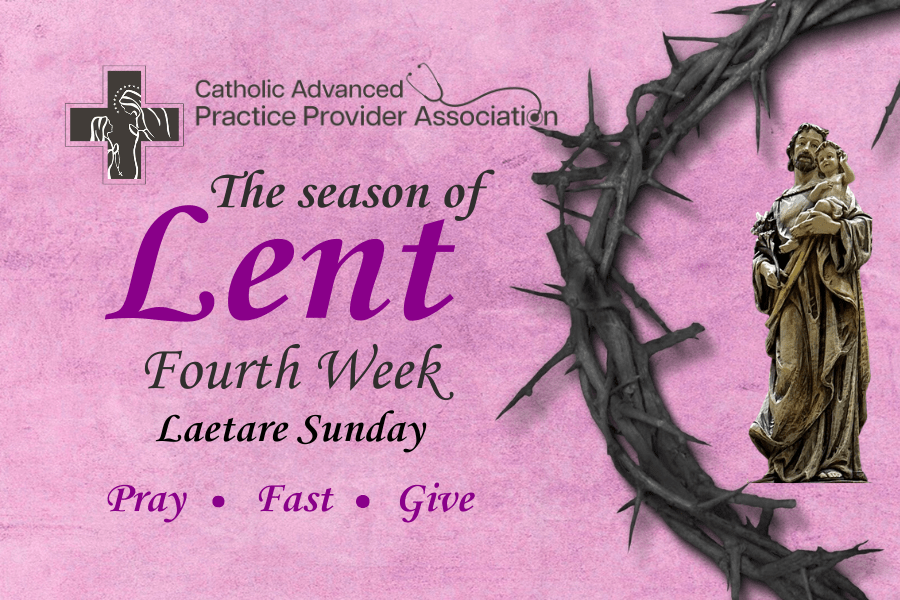
Today is Laetare Sunday. “Laetare” means “rejoice” and is taken from the entrance antiphon (omitted if a processional hymn is sung) that begins, “Rejoice, Jerusalem, and all who love her.” Let us rejoice having reached the mid-point of Lent!
Let us also rejoice in anticipation of the approaching solemnity, the feast of Saint Joseph, Spouse of the Virgin Mary on March 19th. This feast day is the reason why March is traditionally the month dedicated to Saint Joseph, patron of the Church. Because March 19th is a solemnity, you can put aside your Lenten fast since we do not fast when we feast.
If you follow CAPPA’s social media, you have seen daily posts for the Novena to Saint Joseph asking for his intercession for CAPPA, our members, our patients, and for Catholic healthcare.
Saint Teresa of Avila, foundress of the Carmelite Order, and a Doctor of the Church – with the title “Doctor of Prayer” – wrote this in her autobiography The Life of Saint Teresa of Jesus:
I took for my advocate and lord the glorious Saint Joseph and commended myself earnestly to him; and I found that this my father and lord delivered me both from this trouble and also from other and greater troubles concerning my honor and the loss of my soul, and that he gave me greater blessings than I could ask of him. I do not remember even now that I have ever asked anything of him which he has failed to grant. I am astonished at the great favors which God has bestowed on me through this blessed saint, and at the perils from which He has freed me, both in body and in soul. To other saints the Lord seems to have given grace to succor us in some of our necessities but of this glorious saint my experience is that he succors us in them all and that the Lord wishes to teach us that as He was Himself subject to him on earth (for, being His guardian and being called His father, he could command Him) just so in Heaven He still does all that he asks.
That Saint Joseph “succors us in them all” is reflected in his many titles. You have seen some each day of the novena; we can see many more in the Litany of Saint Joseph. One title of particular importance for health care is Patron of a Happy Death. In the New Testament, we hear no more of Saint Joseph after he and Mary find Jesus in the temple after searching three days for Him. Tradition holds that Saint Joseph died before Jesus entered His public ministry and therefor died in the arms of Jesus and Mary. This imagined scene has been artistically depicted throughout the life of the Church.

Daily I call upon Saint Joseph to intercede for the restoration of the Catholic understanding of human dignity as revealed by the Incarnation throughout the world beginning with Catholic healthcare in the United States. This prayer arose out of my work to prevent the legalization of physician-assisted s**cide in Massachusetts, an effort in which I have been involved since 2014. Every other year I testify as to why this practice should not be legalized. Now that New York and Illinois have legalized it, more money and effort will shift into Massachusetts in the years to come. Our prayers must persist.
As part of this effort, the pastor of my parish began the Novena to Saint Joseph to pray for the seriously and terminally ill and to stop doctor-prescribed s**cide. Over the years, I have been honored to speak three times. Here are links to the audio recording of my talks: 2019, 2021, and 2024. Father Gavin has spoken every year since it began in 2012; I only began recording the talks in 2017. You can listen to any of the talks at the novena page on my Nature and Dignity website.
End of life care is an area of medicine particularly fraught with bioethical concerns. Part Five of the Ethical and Religious Directives for Catholic Health Care Services (ERDs) specifically addresses these many issues. What is in keeping with the teachings of the Catholic Church, while guided by several principles, is dependent on individual circumstances, is prone to misinterpretation (like the Principle of Double Effect and Benefit v. Burden), and is distorted by a hedonistic culture that seeks to avoid suffering even in the form of disabilities. This is why understanding and discussing Catholic bioethics is so important to CAPPA., and why I ask for the powerful intercession of Saint Joseph for help.
Let us rejoice that CAPPA has become a reality. Please consider a financial donation so CAPPA can invest in the resources we need to serve our members, and have a blessed rest of the Lenten season.


Leave a comment