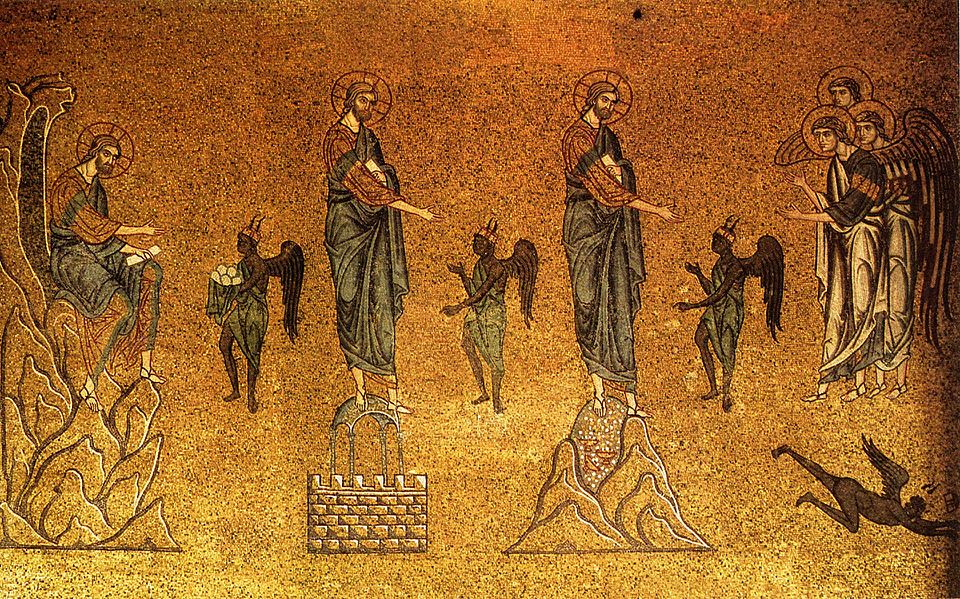

In order to better understand the profound nature of the Lord’s temptation in the desert that incident must be linked with His earlier baptism in the Jordan River (Mt 3:13-17). Immediately after Jesus was baptized by John, the Holy Spirit directly led Him into the desert for a crucial preliminary test of both His character and fidelity to the mission that the Father gave Him. In other words, does Jesus indisputably believe the words of affirmation and approval spoken earlier by the Father at the Jordan or not? Can Jesus (in his humanity) truly rest in and rely upon the Father’s goodness and love to provide and guide Him along the journey towards fulfilling that mission? Or will the evil one be able to plant enough of a doubt in His mind to warp and twist Jesus into being willing to short-cut that redemptive plan?
The unspoken link between those two events is the endorsement that comes to Jesus by hearing God the Father’s words of approval and affirmation. No doubt those words that Jesus heard from the Father, “This is my beloved Son, with whom I am well-pleased” (Mt 3:17), had to have been emotionally and spiritually energizing. To rise up from the water and to be reminded of that He was the eternal all-encompassing divine delight of God would certainly offer encouragement to Jesus for any task that might lie ahead.
The immediate task for Jesus to face was this preliminary forty days of fasting in the desert before his official public activity would begin. The Greek word eremos (Gk. ἔρημος), translated as either desert or wilderness, describes a very solitary, lonely, desolate, and secluded place. Out in that deserted place, there was no audible voice of the Father to be heard, nor any Holy Spirit descending in bodily form like a dove either. Jesus is totally alone and must be lonely. He is away from the adulation of the crowds and totally by Himself. In essence, Jesus has precipitously fallen from the spiritual high of His baptism to the utter isolation of the desert practically immediately does one follow the other. While many people have experienced such a type of abrupt transition, it was not in such an extreme, debilitating form, such that isolation and despair are almost predictable – even expected.
The devil’s temptation began at Jesus’ weakest point, when hunger pangs were their strongest, at the point, the enemy came to tempt Him. In reality, the word temptation (Gk. πειρασμός) does not even begin to do justice to the cosmic battle that was being played out in the desert between Jesus and the devil — a titanic moral struggle was underway.
The Nature of Temptation
The nature of temptation, using the Lord’s temptation in the desert as that experience’s prime example, is that being tempted is not sinful; even many who are tempted the most often remain innocent of actual sin. Though it is true that, in and of itself, temptation is not sin, nevertheless temptation and sin are very often allied — very like each other—and one can easily be mistaken for the other.
Temptation must be seen as the occasion of sin. Temptation can, quickly and with great ease, pass into sin. Temptation, according to the Catechism of the Catholic Church is defined like this, “Temptation is an attraction, either from outside oneself or from within, to act contrary to right reason and the commandments of God. Jesus himself during his life on earth was tempted, put to the test, to manifest the opposition between himself and the devil and the triumph of his saving work over Satan” (CCC, n. 538).
We live in a world that has increasingly blurred the lines between what is right and wrong. It is more and more difficult to tell good from evil. Yet, take comfort in the fact that God is faithful and will never abandon us. He will always offer us a way out of any predicament no matter how serious. Fighting temptation is a daily struggle and there will be times when you will fall. Instead of wallowing in despair, immediately repent. Go to confession, which requires that you first engage in an examination of conscience – an honest look into the dusty corners of the soul.

Leave a comment