The liturgical seasons of the Catholic Church unite the community of believers, Lent particularly so. Together we deepen our disciplines of praying, fasting, and almsgiving as we contemplate the coming remembrance of the sacrifice Christ made for the sins of which we are atoning. No longer captives of the devil, the insurmountable debt we owe God for our sins against Him, impossible for us to repay, has been paid by Christ, our Original Sin removed through Baptism, and personal sin forgiven through Reconciliation. We are washed clean in the blood of the Lamb. Out of our great love for Christ, we desire to repent, turn away from sin, and grow in holiness and virtue with God’s grace.
While the season of Lent spans 46 days, we do not fast on Sundays since those are feast days of the Resurrection; thus, Lent consists of fasting for 40 days. This is in imitation of Jesus, who was led into the desert by the Holy Spirit to fast for 40 days where He was tempted by the devil, Satan (Mk 1:13, Luke 4:2, Mt 4:1). Mark’s version is brief (1:12-13), whereas Luke (4:1-13) and Matthew (4:1-11) give us the full and familiar account, the latter being today’s reading. At the end of the 40 days of fasting and temptation, of which we are given no details, we are told of three particular temptations that occur. Many Catholic theological insights have been written about these temptations. I simply want to consider this exchange as it may relate to APPs in today’s healthcare system.
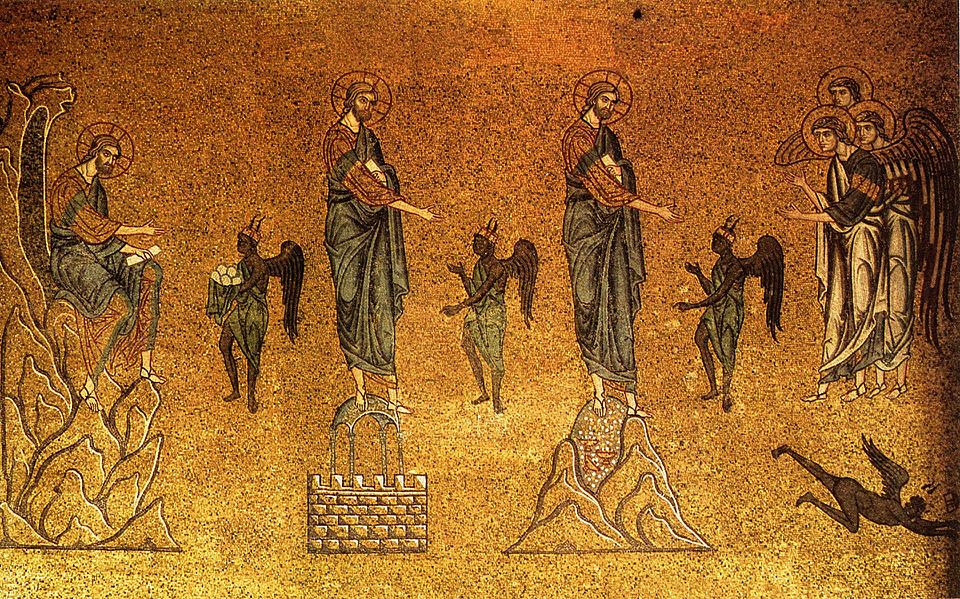
Satan knows Jesus is the Messiah and suspects he is divine, so he tests Jesus (see this quick explanation why). Jesus’s every answer to the devil’s goading is to trust in the Lord. To start, Jesus is famished from fasting, because he is human; he could turn the stones into bread for His nourishment, because he is divine. But doing so to satisfy Satan’s unbelief would serve Satan, while resisting Satan despite his hunger brings glory to the Father. Jesus replies with part of Deuteronomy 8:3:
“And he humbled you and let you hunger and fed you with manna, which you did not know, nor did your fathers know; that he might make you know that man does not live by bread alone, but that man lives by everything that proceeds out of the mouth of the Lord.”
Today, our bodily needs, the very things we and our families need to survive, are generally supplied through our finances. We may be led by the Holy Spirit into the desert of relinquishing our financial stability. This might be from illness, or foregoing a climb up the corporate ladder, even cutting back at work to better serve our children, or refusing to accept or participate in the growing offenses to human dignity in healthcare despite the consequences. Trust in the Lord.
Satan next “made” Jesus to stand atop the temple pinnacle and again asks Jesus to prove he is the Son of God by throwing himself off. In a tit for tat taunt, now Satan quotes Psalm 91:11-12:
For he will give his angels charge of you
to guard you in all your ways.
On their hands they will bear you up,
lest you dash your foot against a stone.
Jesus again refuses, replying with Deuteronomy 6:16, “You shall not put the Lord your God to the test, as you tested him at Massah.” All of Psalm 91 is beautiful to read as it is an assurance of God’s protection. Do we believe in God’s constant love for us not only when we are tempted but in the face of terrible trials? Even in the common trials like a friend’s betrayal, being turned upon by your colleagues, having a project fail that you have poured yourself into, family strife and disappointment, being overlooked, and other forms of rejection? Jesus, in his human nature, felt these things, too. God does not reject us when the world does. Are we tempted to ask God for proof? Trust in the Lord.
Finally, Satan appeals to our human desire for wealth, power, influence, achievement – everything that supposedly makes us “happy”. Just bow down and worship Satan. Jesus responds by quoting Deuteronomy 6:13, “You shall fear the Lord your God; you shall serve him, and swear by his name.”
The problem is that such temptations are never this obvious. In fact, Jesus’s reply, “Get away, Satan!” reminds me of his rebuke of Peter. Just prior, Peter gives his declaration of absolute faith, “You are the Christ, the Son of the living God” (Mt 16:16), for which Christ bestows on him the keys of the kingdom of heaven. But when Christ speaks of his eventual suffering, death, and resurrection, Peter responds, “‘God forbid, Lord! This shall never happen to you.’ But he turned and said to Peter, ‘Get behind me, Satan! You are a hindrance to me; for you are not on the side of God, but of men’” (Mt 16:22-23).
Sometimes we must sacrifice something good for something greater; this involves suffering. Our chosen Lenten practices remind us of this fact, preparing us for when something terrible happens that we did not choose, or we are faced with doing something we don’t want to do. We are distressed by the imminent suffering without knowing the eventual good that will come and may never know in this life. He gives profound meaning to our suffering through which we participate in His redemption. We may sorrow but be not afraid. Trust in His merciful love.

Leave a comment