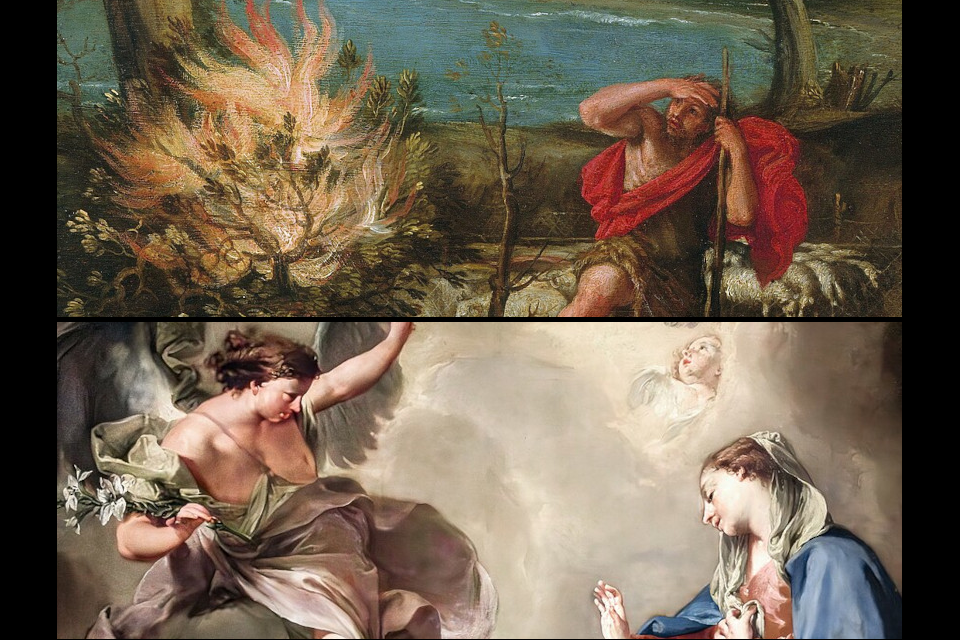
For this Third Sunday of Lent, I want to share with you a reflection written by Msgr. Peter Beaulieu, a diocesan priest, bioethicist, and Director of Mission Integration at St. Vincent Hospital in Worcester, Massachusetts. He reflects on the connections between the Burning Bush (the first reading) and the Annunciation, which, this year, happens to be celebrated in two days. While the central figures in the Annunciation are the Blessed Virgin Mary and the Archangel Gabriel, this is the moment the Son of God emptied Himself (kenosis) of the privileges of His divinity in order to humble Himself by taking on human flesh and frailty in the Incarnation.
The Incarnation, like the Trinity and the Eucharist, is a profound and central mystery of our Faith. It also has great significance for those of us dedicated to the healing apostolate of the Church. As Msgr. Beaulieu writes, “[T]he Word’s taking of human flesh from Mary constitutes the sanctification of all human flesh by the loving Creator.” In the words of Saint Peter Chrysologus, “That the Creator is in his creature and God is in the flesh brings dignity to man without dishonor to him who made him.”
Medicine is dedicated to healing the body and the mind. Catholic medicine recognizes, respects, and is guided by the body’s sacredness; the manner in which we treat our patients and ourselves is revealed by the Incarnation. It is a source of endless contemplation that is our sure guide in our clinical practice.


The Burning Bush & the Incarnation
In the crypt chapel of the National Shrine of the Immaculate Conception in Washington DC, there is a series of mosaics depicting the original fifteen mysteries of the Rosary. Underneath each depiction of the mysteries, an event from the Old Testament is paired with the mystery of the rosary as an anticipation that foreshadowed it. The Annunciation, as the first of the Joyful Mysteries, has, below it, a mosaic of the burning of the bush as the Old Testament event that foreshadows, or is the typology of, the angel’s visit to Mary. Thus, Gabriel’s annunciation to Mary that she was destined to be the Mother of God and the call of Moses at Mount Horeb by the voice of God coming from within the unburnt bush both incidents are linked.
Such a connection has been made since at least the fourth century, when St. Gregory of Nyssa observed, “The light of divinity . . . did not consume the burning bush, even as the flower of her virginity was not withered by giving birth.” The burning bush or unburnt bush signifies the result of the Annunciation and Mary’s fiat, namely, the Incarnation of the Son of God. Just as the fire did not consume the bush, so the divinity of Jesus did not destroy His humanity. The burning bush, where God spoke to Moses, is perceived to be the typological parallel to the Annunciation and the Incarnation. The bush burned without being consumed, mirroring how Mary conceived the Word of God or Jesus as a virgin and remained perpetually so.
In order to fully comprehend the significance of the connection between the Virgin Mary and the Burning Bush, it is essential to delve into the biblical account of the encounter Moses had at Mount Horeb. The Book of Exodus narrates the account of Moses, who, while tending his flock in the desert, encountered a bush that burned with a unique kind of fire that did not consume the bush. The voice of God emanates from within the fire, revealing sacred knowledge and divine purpose to Moses. This awe-inspiring event marks the beginning of Moses’ prophetic journey and is the beginning of the eventual freedom of the Israelites from Egyptian slavery. Thus, the Burning Bush represents an extraordinary theophany, a direct manifestation of God’s divine presence, coupled with asking Moses to embrace a sacred mission. Moses’ encounter with the Burning Bush signifies a transformational experience, guiding him to become a spiritual leader and a messenger of God’s will.
Just as in the Exodus narrative the bush is on fire and burning, yet the bush is not consumed, remaining untouched by the flames, so too at the Incarnation divinity enters into Mary’s womb and, though contained by her womb, her womb is not destroyed by the fire of divinity within. The Incarnation of God is the refutation of all distorted understanding of the body and the material world.
Contained in the flesh of Jesus Christ, when He lies as the unspeaking Word (Lat. infans) in the manger or He breathes His last on the Cross, the Word’s taking of human flesh from Mary constitutes the sanctification of all human flesh by the loving Creator. Yet, though the burning bush remained intact despite being aflame, the Incarnation has become a theological principle. Because the Word of God became flesh or matter (the human body is mostly water and carbon) in the person of Jesus, consequently, the Church believes that matter can become divine, sanctified, and a source of sacramental grace. This is called the ongoing Incarnational Principle.
You can read more of Msgr. Beaulieu’s weekly reflections and see my work to prevent the legalization of assisted suicide in Massachusetts on my own website Nature and Dignity.

Leave a comment